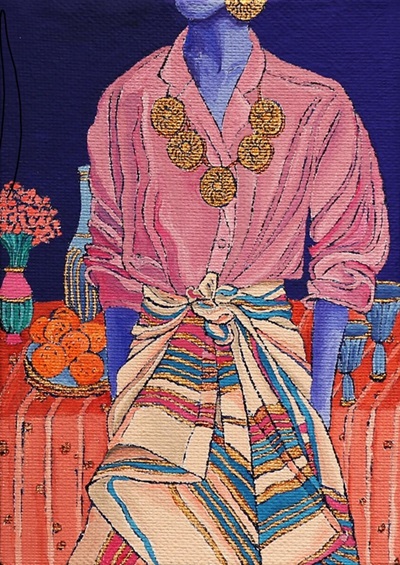
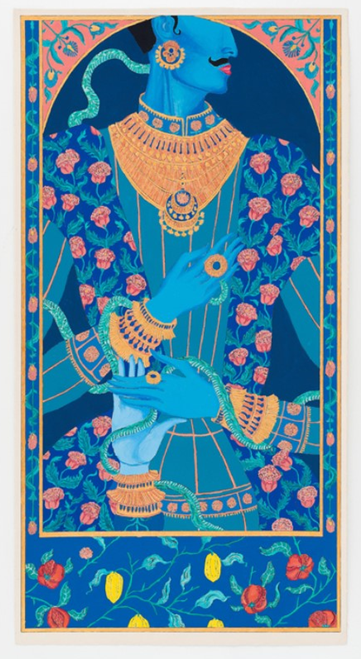
Shakil Solanki is a young South African Indian artist whose work – which takes the form of prints and paintings, is reminiscent of historic Persian and Hindu miniature paintings, featuring similar decorative borders, rich colours and intricate details. Closer examination of his subject matter reveals a contemporary engagement with themes of gender politics, identity, and culture.
Central to his practice are his experiences and identity as a ‘queer brown man’. In defining the focus of his art , Solanki says:
“exploring and expressing vulnerability was the starting point for my work, engaging many dualities of intimacy, sorrow and tenderness. While these dynamics of intimacy and vulnerability still very prominently underscore my work, a fuller spectrum of emotions is slowly being developed, with moments of celebration and stillness finding their way into my practice. Above all, the aim is to have these experiences all equally relayed in a delicate, sensitive visual manner”.
The backdrop to all his work is the idea of a secret garden, which can be lush and beautiful, or dark and dangerous. This metaphorical space is where he explores these complex emotions and experiences.
*Featured artwork above. Solanki, You take my Face in Palm and call me the Morning Sun- Banquet I. Gouache on canvas, 14.7 x 10.3 cm (2021)
BIOGRAPHY
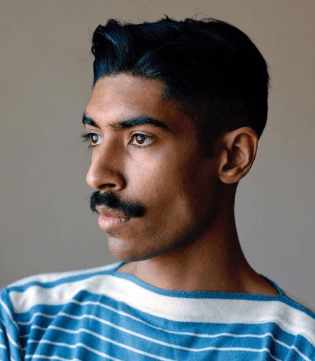
Shakil Solanki was born in Cape Town in 1997. He completed an art degree at Michaelis in 2019, and was awarded the Simon Gerson Award, as well as the Katrine Harries Print Cabinet Award, for his achievement in printmaking. Since then Solanki has undertaken residencies at the South Atlantic Press and the Krone x WHATIFTHEWORLD residency at Twee Yonge Gezellen in Tulbagh. He has exhibited in numerous group shows, and had two solo exhibitions Yumeji’s Theme (2020) and The Pearl Fishers (2023). Recently Solanki produced a series of paintings which were used as the backdrop to the Cape Town Opera’s production of The Pearl Fishers. He has also collaborated with Fields Store and the L’Mad Collection to produce clothing items bearing his signature prints. Solanki works as a full time artist and is based in Cape Town.
HIS WORK
Solanki works primarily in the mediums of printmaking and painting. Much of his inspiration is drawn from his Indian cultural background, as is evident in the image below, A Sumptuous Palace opens itself to our Gaze, Our Rapid Flight carries us to the Heavens. This painting formed the backdrop for ‘The Pearl Fishers’ and features the three characters caught up in the tragic love story.
Solanki has always held “a very deep fascination for the visual culture of Hinduism; its vibrant colours, intricate patterns, and rich fabrics”. Despite the conservative and traditional values espoused by Hinduism, he views the depiction of male gods with blue skin and ornate jewellery and clothing through a different lens.
“It’s this very camp aesthetic language which I choose to tap into, building a bond between my queerness and culture- a subversion of these conservative values, into what I hope is a more progressive, fantastic vision”.
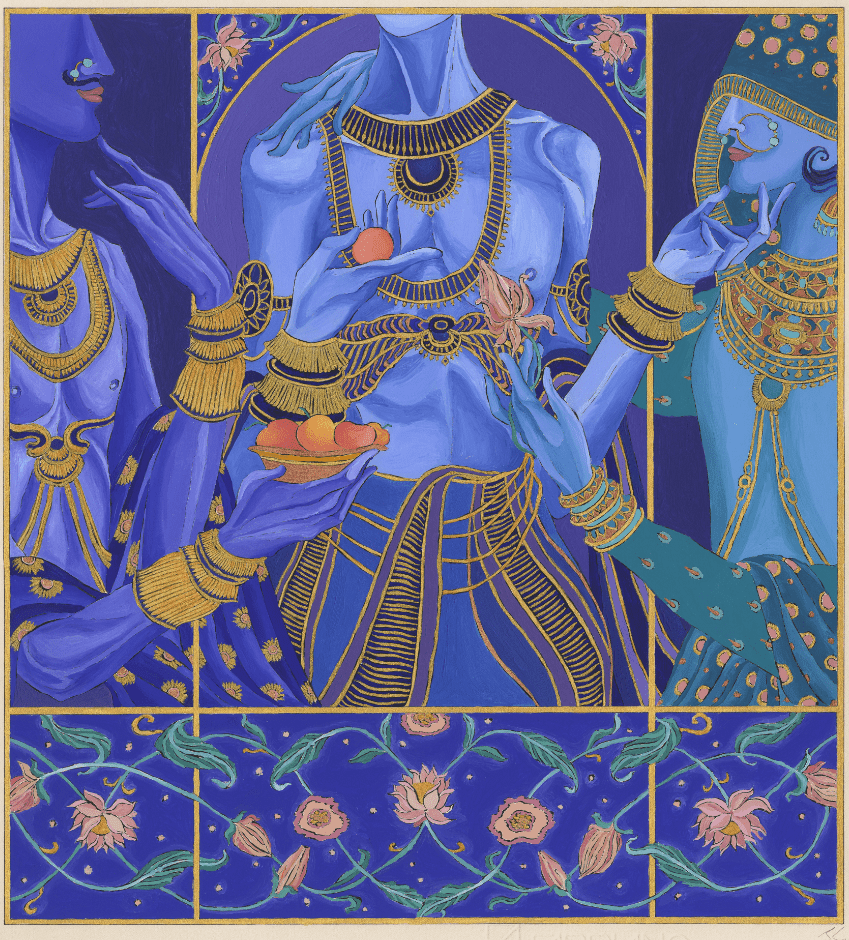
us to the Heavens, Gouache on paper, 44 x 38 cm (2023)
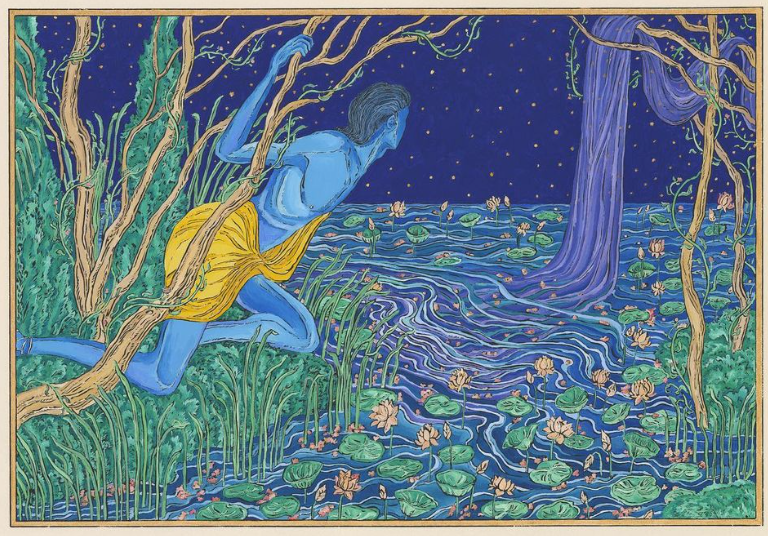
Solanki uses the concept of a “secret garden as a liminal, dreamlike space to explore dualities of tenderness, desire and violence…as well as the dynamics of intimacy”. In the two works below, Silly Little Fool, anything can Happen, and You’re also a Monster. But so am I-which is why I can’t turn away from you II, these dualities are thoughtfully explored in works that are both romantic and disquieting.
“I think there’s an underlying violence inherent in any intimate encounter- that potential for harm is never far in an emotional relationship with another. As humans, we are capable of inordinate amounts of destruction, emotionally and physically; I’ve felt that this has never been more prevalent than with those who we choose to be our most vulnerable selves with. I’ve also found, as part of a queer community, danger is never too far off, just in expressing ourselves truthfully”.
The carefully chosen titles support the intention of the artworks themselves. In Silly little Fool, the idyllic natural setting comes with a warning to the young man to not be too trusting. In ‘You’re also a Monster’, this unease is communicated in the form of the snake which winds around the body and a mysterious third hand which reaches out from beyond the picture frame.
Solanki often uses his own image or body as a starting point for many of his artworks, in doing so he allows himself to become vulnerable and exposed.
“The self portraiture is something that I’ve grown more comfortable with doing over time. It feels as though it adds a layer of personal authenticity. Posing for myself also makes experimentation easier, playing with a variety of bodily ideas that are then translated into works”.

In the print You are afraid it may change you, two figures embrace, while flowers and plants weave around them. Their faces are turned away and cannot be seen. This is a common characteristic of many of Solanki’s artworks, subjects are usually shown from the neck down, faces are turned away or covered. He believes in obscuring his subjects faces, since showing them would “feel too direct and too personal to engage with”. He goes on to say,
“I feel like their presences immediately grab focus, and overshadow the rest of the body. There’s an element of mystery which also develops, allowing for a purely bodily language to be built, as they twist, arc and contort around one another”.
Nicholas Tanner, in describing Solanki’s imagery writes, “although their faces are never revealed,…their emotional content in all its pathos, misery and beauty is laid bare.. their twisted and contorted bodies are endlessly entwined amongst a nature blossoming forth in a tapestry of nostalgic yearning and despair- as if the shape of their bodies implies a painful, strenuous endeavour to emerge out of the oppressive weight of some inner turmoil”.

Shakil Solanki’s work is a reminder that representation in the arts is important, especially for marginalised people, who have historically been either mis-represented or under-represented in art. When we see ourselves, our culture or our own stories reflected in mainstream art, it validates our experiences and creates a sense of belonging and inclusion. Solanki, as part of a minority group, makes art that reflects his experiences as a queer South Asian man. He hopes that others like him can resonate with what he creates, and that they can see pieces of themselves in it.
Solanki shows us a lesser known world that many in our society view with intolerance or distaste, and he shows us that beauty, tenderness and love exist there. He also deals with the complexities, harms and misinformation that come with being queer and brown.
This type of inclusivity in art can raise awareness of the struggles faced by marginalised communities, challenge stereotypes, and dismantle harmful biases. It can promote conversations which lead to understanding, acceptance, tolerance and a more inclusive society. Solanki’s beautiful and sensitive images go a long way to achieving this aim.
RESOURCES
Interview with Shakil Solanki – email correspondence. (1/11/2023)
Constanza, G. Why diversity and inclusion matter in Art. blog, July 2023
https://latitudes.online/artists/shakil_solanki
Maropeng, L. A dreamlike world with Shakil Solanki touching on subjects of tenderness and violence. S A Creatives. September 2023
Artist in Residence – interview – Shakil Solanki, https://krone.world/blogs/journal/artist-in-residence-shakil-solanki
Nicholas Friederich Tanner, WHATIFTHEWORLD is pleased to present Shakil Solanki’s first artists presentation – An Ode to Yumeji’s Theme. 2020
Berens, G. Shakil Solanki. Some Other Label. May 2020
 Curating Culture
Leave a comment