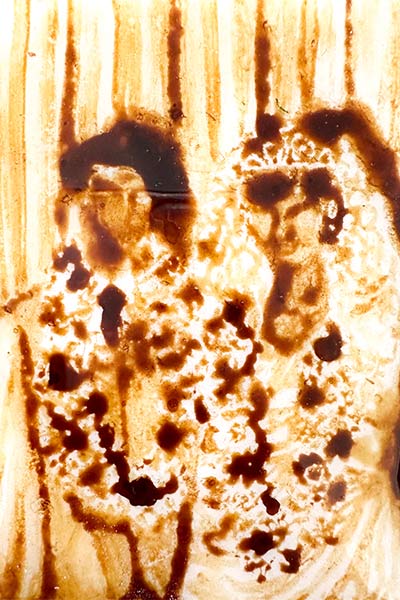
Zenaéca Singh is an artist whose preferred medium, sugar, may appear to be an unusual choice, but for her, sugar and its byproducts are intrinsically linked to South African Indians’ heritage and history. Like most South African Indians, Singh’s forefathers came to South Africa as indentured labourers, who primary worked on the sugarcane farms of Natal (later Kwazulu Natal). She says, “I am a descendant of indentureship, but also a born-free citizen, so questions of freedom and belonging were always interesting yet peculiar to me, as I did not know a lot about indentureship”. She believes that art is a way to process her questions about the history of indenture and also provides a visual language to explore this history in a more imaginative and relatable way.
My use of sugar expands on its cultural economy to include the lost history of indenture, connecting the nuances between slavery and indentureship. The sticky residues of the archive reflect the slow violence of indentureship, while the sweetness signifies the hopes of descendant communities to reconcile with their historical trauma (Singh).
BIOGRAPHY

Zenaéca Singh grew up in Port Shepstone, in KwaZulu Natal. Despite her family’s wish for her to be either a dentist or engineer, she chose to study art. Typical of most Indian communities, she says, “art wasn’t even a consideration as a legitimate career in my family”(nataal.com/belonging).
Singh has since completed her Masters Degree in Fine Art at the University of Cape Town’s Michaelis School of Fine Art. As a student, she was the recipient of several awards as well as a scholarship from UCT – the “Accelerated Transformation of the Academic Programme”- which allowed her to complete her Masters Degree. Singh has participated in several exhibitions and art fairs, and has artwork in several collections. In 2024, she was commissioned to create work for the Fenix Museum of Migration in the Netherlands.
ARTWORK
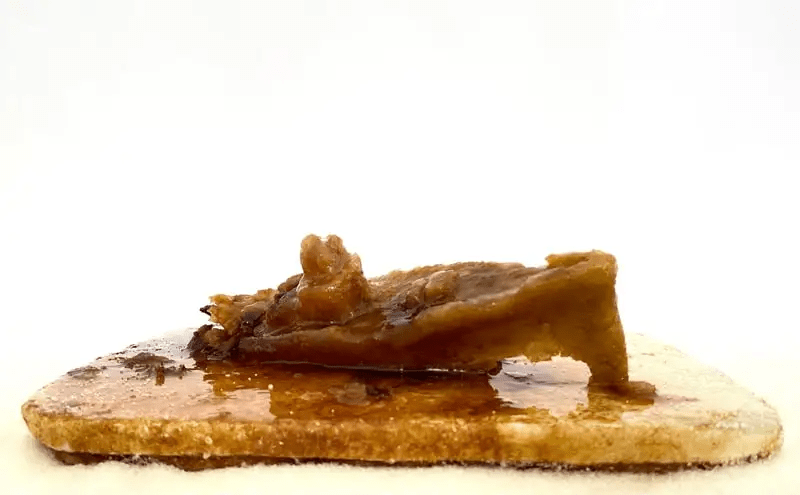
Singh’s practise as an artist involves painting, creating installations and sculpture. The sculpture featured above is of a melting ship made out of sugar and resin, its title SS Truro refers to the first ship to bring Indian indentured labourers to South Africa (SA) to work on the sugar estates in Kwazulu Natal. Singh’s work explores the complex history of the sugar economy in SA and its link with exploitive labour practises, colonialism and migration. More than 150 000 Indians migrated to Kwazulu Natal between 1860 and 1911 lured by the promise of better job opportunities within the sugar industry. Unfortunately, the reality that awaited them were draconian working conditions, paltry wages, and systemic injustices on the sugar estates (iol.co.za/ios/news/2025-09-05-capturing-history-artist-explores-the-story-of-indentured-indians).
The melting ships symbolise the fluid relationship between South Africa and India, both colonised by Britain in the late 19th century. The ships are “frozen in a state of perpetual transition and collapse,… both fluid and static, borne of the past and unresolved in the present and future”( Singh). They also refer to the tenuous identity of indentured labourers as they moved between both countries, seemingly belonging to neither. Indians were only officially recognised as South African citizens in 1961, despite the fact that by then, there was already a second generation of South African Indians who had been born in this country.
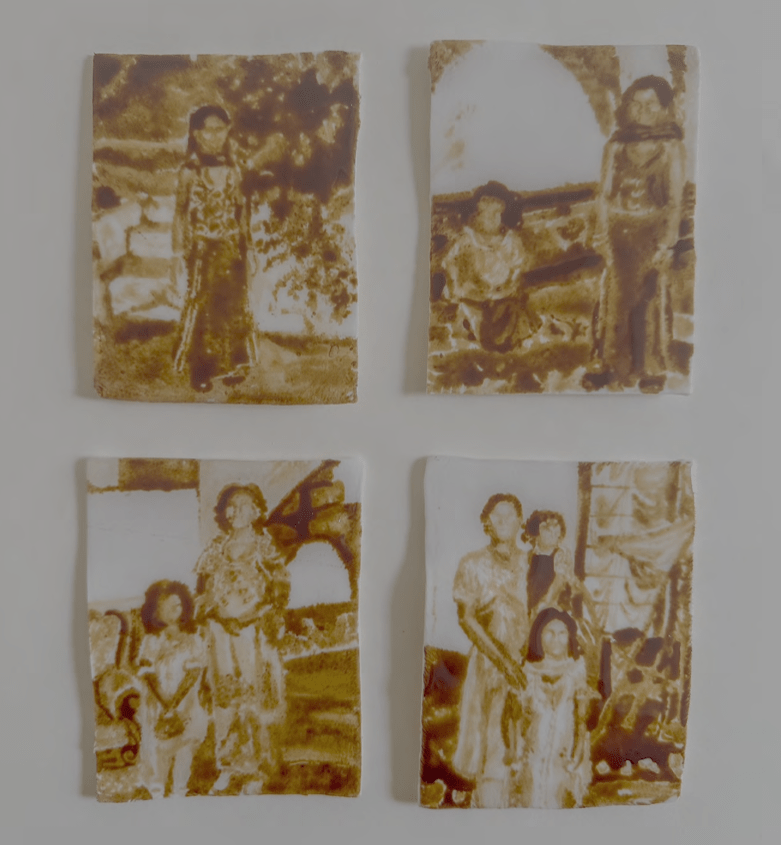
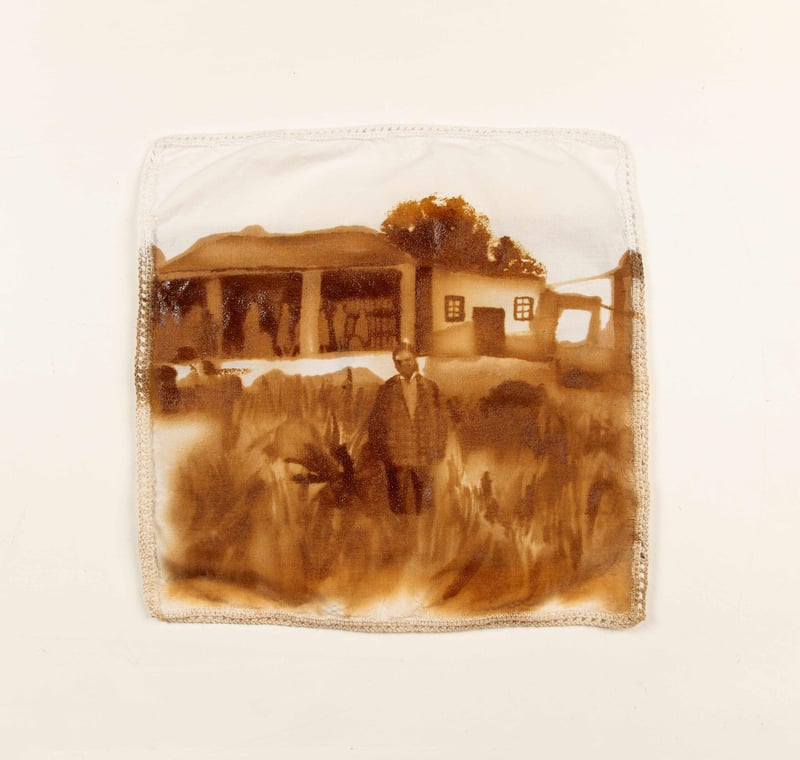
Festivities Series above, is part of a series of molasses paintings of old family photographs on sugar paste, called Bittersweet Impressions. The images capture the happy memories of families dressed up for celebrations and reflect close family bonds. Singh’s method for creating this type of ‘painting’ is labour intensive; it involves making a sugar paste ‘canvas’, then painting it with molasses before setting it with resin. Singh uses images from her family archives, citing these images as ‘powerful’ since they reflected how Indian immigrants created a sense of home and family despite overt racial discrimination and colonial practises that viewed them as nothing more than temporary labour.
Since the viscosity of the molasses prevents Singh from rendering details in the paintings, the images created are blurry and unstable. She believes that it allows her family members some privacy by making them less identifiable. The indistinct faces also allow viewers to relate to their own memories of family and ancestors. Singh also points out that “her work is ephemeral…because of the sugar, and its important for her to see how it ages and holds meaning”(email interview).
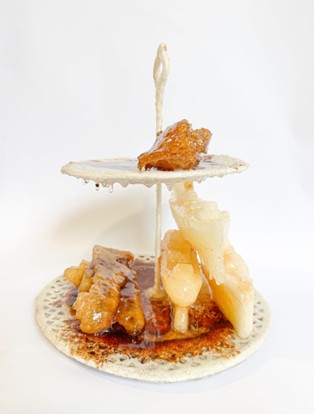
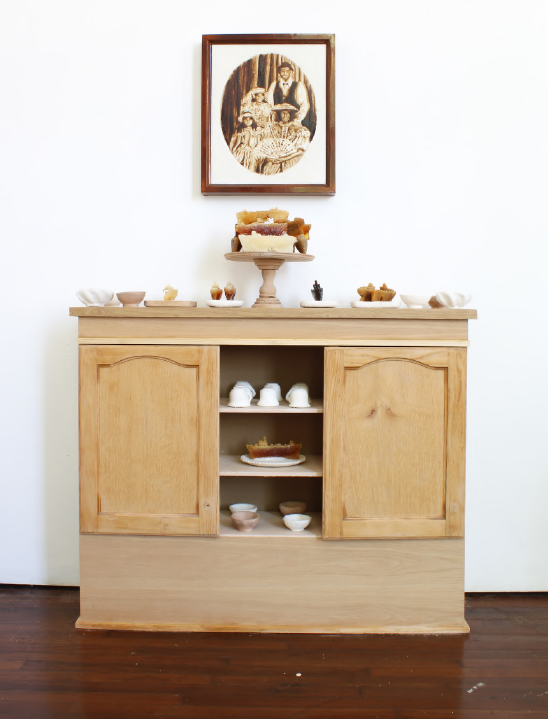
The above two images show an installation titled Sweetened Belongings, and a detail from it titled High Tea. The Display Cabinet recalls the domestic interiors of British colonial homes, an influence that later spread to Indian homes. It is filled with sugar and resin crockery, ships, and sugar packets. The British concept of High Tea relied heavily on the sugar industry for the sugary confections that accompanied the tea. Both of these commodities, tea and sugar came from colonised India and Natal respectively. High tea as a British institution indicated wealth and leisure – wealth acquired from these colonial industries and leisure afforded by access to a large cheap workforce. Indian indentured women were also employed as domestic help, nannies and cooks. Singh points out that the contribution and challenges faced by indentured women has largely been forgotten by history. This is why many of her installations and images focus on the domestic and home life of early immigrants.
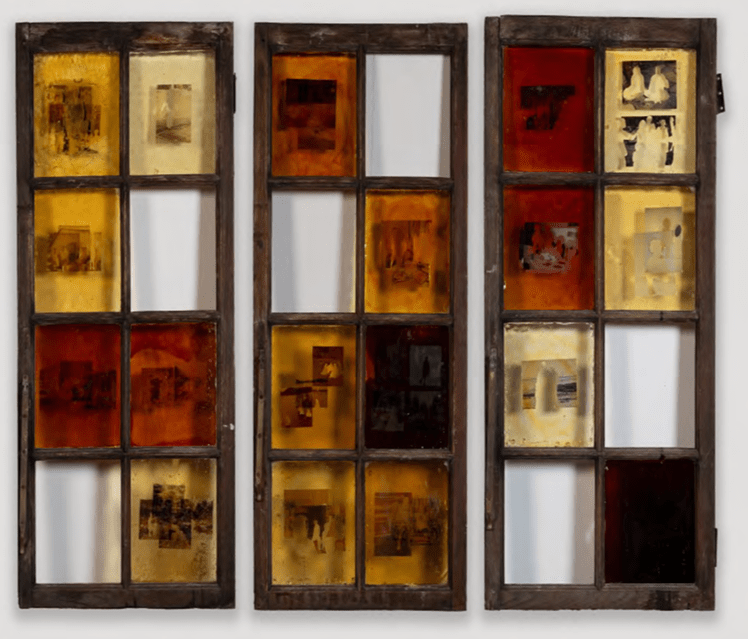
The installation, Finding Myself, (above) features glass panes made from crystalized sugar, and imprinted with images from Singh’s family archives.
Sugar glass evokes sweetness and fragility—desirability and disruption. Through layered collages, I challenge binaries of inside/outside and emphasize the need to look in-between. (Singh)
The images on the glass are either silhouettes, or layered and hazy preventing them from being clearly seen. Singhs’ intention here is to change the subject from being the static object of the colonial gaze, to being one that is unstable and open to interpretation by the viewer.
“The ships and sugar become signifiers for the dispensation of indentureship and become bitter-sweet reminders and confrontations with this sugar-coated history”. According to Singh, the history of SA Indians has been ‘sugarcoated’, as evidenced by indenture being framed by colonial governments as opportunities for free labour and advancement. During the apartheid era, middle class Indians were held up as examples of a ‘model minority’ who sought upward mobility and success, while assisted by a benevolent government. This narrative hid the reality of inequality, racism, discrimination and the struggles of the poor working class.
Singh cites Homi Bhabha’s Location of Culture, Jordache Ellapen’s writing on brownness and intimacy and Khal Torabully’s Coolitude, as being important influences on her work. Like them she deals with themes of identity, migration, marginal histories and notions of belonging. Her intention as an artist is to interrogate the history and lived experiences of our past, while honouring the labour of our ancestors.
RESOURCES
Email interview with Singh, Z
Featured image it top of article; Dada and Ma (detail) molasses on sugar paste and resin.
Portfolio-Zenaeca-Singh-2025. (gunsandrain)com
humanities.uct.ac.za/michaelis/zenaeca-singh
nataal.com/belonging)
iol.co.za/ios/news/2025-09-05-capturing-history-artist-explores-the-story-of-indentured-indians


Leave a comment